
ReadingsA Hunger Artist
Josephine and the art that cannot be saved
Kafka's last collection is about performers whose skills no longer matter to anyone — and about what remains when the audience has gone home.
Mira S.
16 October 2026
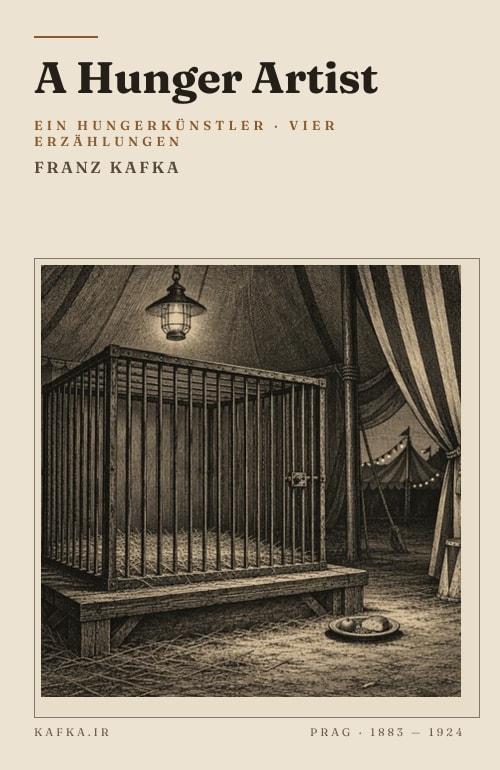
Ein Hungerkünstler
The last collection Kafka prepared for publication: a professional faster, Josephine the singer, and three more stories about art, the body and the world's indifference.
“A Hunger Artist” is the last collection Kafka prepared for publication himself, in 1924, a few months before his death. It contains four stories: “A Hunger Artist,” “Josephine the Singer,” “First Sorrow” and “A Little Woman.” All of them concern an artist who offers something to the world, and a world that either does not understand, is briefly entertained, or turns away.
The title story is about a man whose art is fasting. Once, spectators queued to see him; now nobody cares. He fasts in a cage and at the end confesses that he never found the food he liked. That sentence can be read as a statement about art, about faith, or about Kafka himself.
These are four short stories, but each is a complete system. If you liked “The Metamorphosis” and want to see what Kafka did with the same ideas at the end of his life, start here.
This collection appeared in 1924, the last year of Kafka's life, and contains four stories: “A Hunger Artist,” “Josephine the Singer,” “First Sorrow” and “A Little Woman.”
“I always wanted only one thing: that you admire my art of fasting.”
“Because I could not find the food that tasted good to me.”